
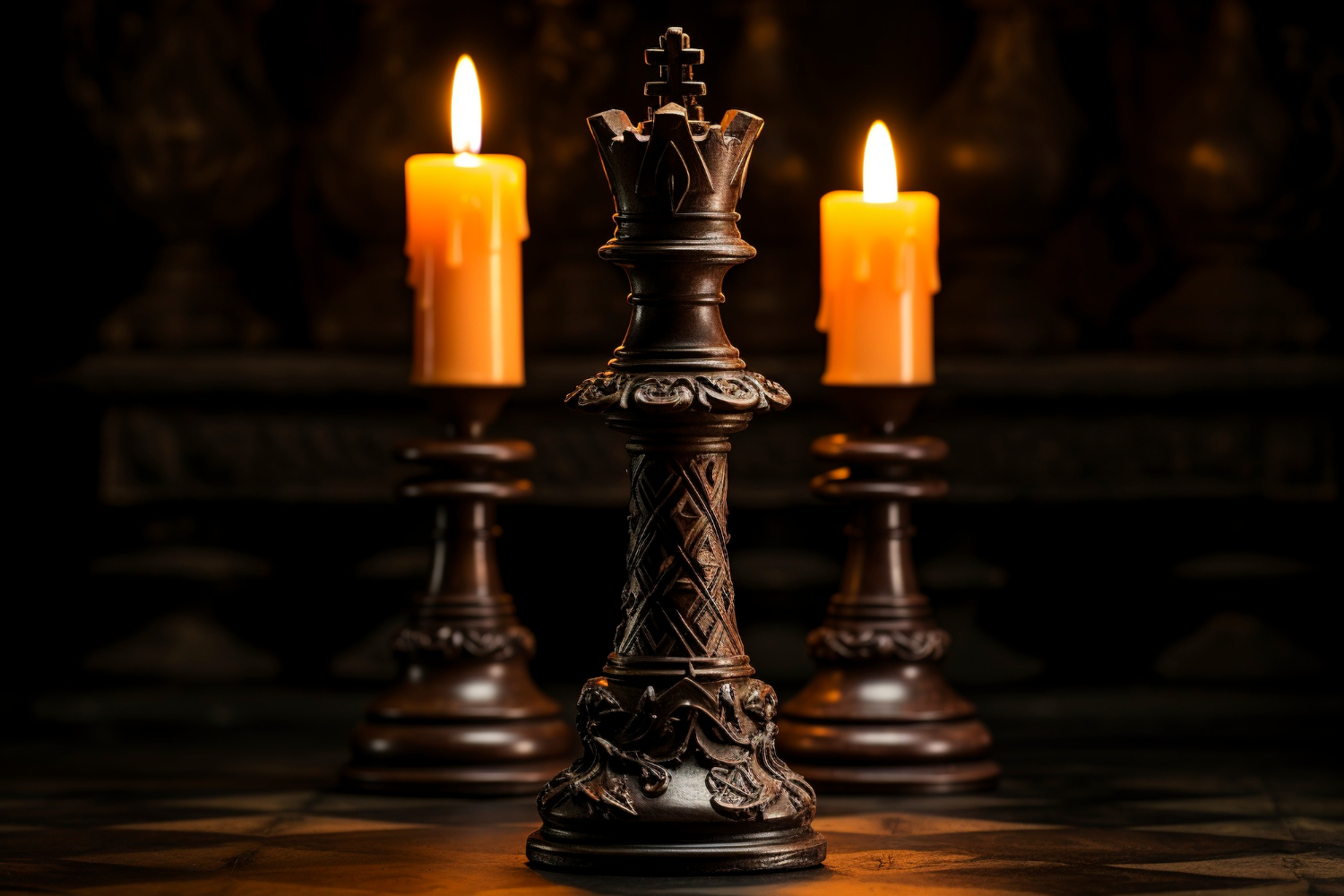
My dear boy,
Chess, a strategy game played by two players on an eight-by-eight board with 64 squares, is a beautiful game. The hallowed ground is ever ready to take the unprepared: knights falling, pawns sacrificed, vicious queens dripping with blood. The board has turned men into magicians and made immortal mortals. The goal of chess is to checkmate the opponent’s king, meaning the king is under attack and cannot escape capture.
There’s no denying its ability to heighten attractiveness, should you know how to play. Nevertheless, it is not real life. Can it teach you a lesson or two that can prove instrumental in navigating the world? Most definitely. But it does not accurately capture reality as we have it, in that no two persons have the same pieces. Not even your classmates or age mates are furnished with the same options.
Each player starts with 16 pieces. The king moves one square in any direction. The game ends if the king is trapped while in check. Each player can only have one King. The Queen, however, moves any number of squares in any direction, straight or diagonal. It is nonetheless the most powerful piece. Although the Rook moves any number of squares, it can only move horizontally or vertically. The Bishop moves any number of squares diagonally. The knight moves in an L-shape, two squares in one direction and one perpendicular. Worthy of note is that it can jump over pieces. The Last, and certainly the least, is the Pawn. It moves one square forward but captures one square diagonally forward. On its first move, it can advance two squares. The beautiful game is nuanced enough to accommodate special rules such as castling, en passant, and promotion.
When I set out to write you this letter, my heart was set on showing you that pawns could become kings, establishing my argument using the bumblebee-cannot-fly myth. I do not deny that I have heard that myth many times to believe it. I am, however, embarrassed to admit that I had somewhat believed it until now. Writing does make an exact man, my boy.
Having my assumptions proven false, as I attempted to build on them, should have left me distraught. But wouldn’t that defeat the ultimate goal for writing: enlightenment? A popular myth holds that aerodynamics proves bumblebees should not be able to fly. This myth is drawn from a 1930s experiment, in which some early scientists applied fixed-wing equations to bee wings. According to those equations, the bee’s wings looked too small for its body weight. However, the problem was the model.
Observe that airplane equations assume rigid wings and continuous airflow. Nevertheless, bees do something different. The flight of bumblebees follows more complex aerodynamics. Rapid wing beats (about 200 times per second), rotating wings, and the creation of mini-vortices (swirling air). These vortices then create extra lift, allowing the bee to stay airborne. This, my dear boy, falls under the study of unsteady aerodynamics in fluid mechanics. This behavior is explained by aerodynamic vortex dynamics rather than by airplane-style lift equations. Hence, bees do not violate physics; the early model was simply incorrect.
My dear boy, certain laws are cast in stone; there is no change in them. Fools may try. Oh, how they do try! Just as none can serve two masters at a time, it is folly to think that pawns could become kings. If that ever happened, it would be a circus with career clowns in high spirits, in full display.
See, when a pawn reaches the final rank, the rule is called promotion. Owing to this rule, a Pawn can become a Queen, a Rook, a Bishop, or a Knight, but not a King. This is because the game must always have one king. It makes sense, in that the entire goal of chess is built around attacking that single piece. However, if pawns could promote to Kings, a player might have multiple kings; hence, check and checkmate rules would break down.
Moreover, chess evolved from the ancient Indian game Chaturanga, where the king represents the leader of the army; there was always one ruler. In addition, allowing more kings would make the game chaotic and remove its main objective.
It, therefore, follows that each context, simulation, or environment assigns a role to every character, and there is a cap to the height each character can attain. To exceed that height places a demand to break free from that environment, or should they choose to remain, the rules must change, therefore altering the goal or objective of the environment. See, environments conform men, and I remain committed to providing you the best environment there is.
Again, I ask you, my dear boy, are there indices to suggest that pawns can indeed become kings?
Love,
Dad.
