
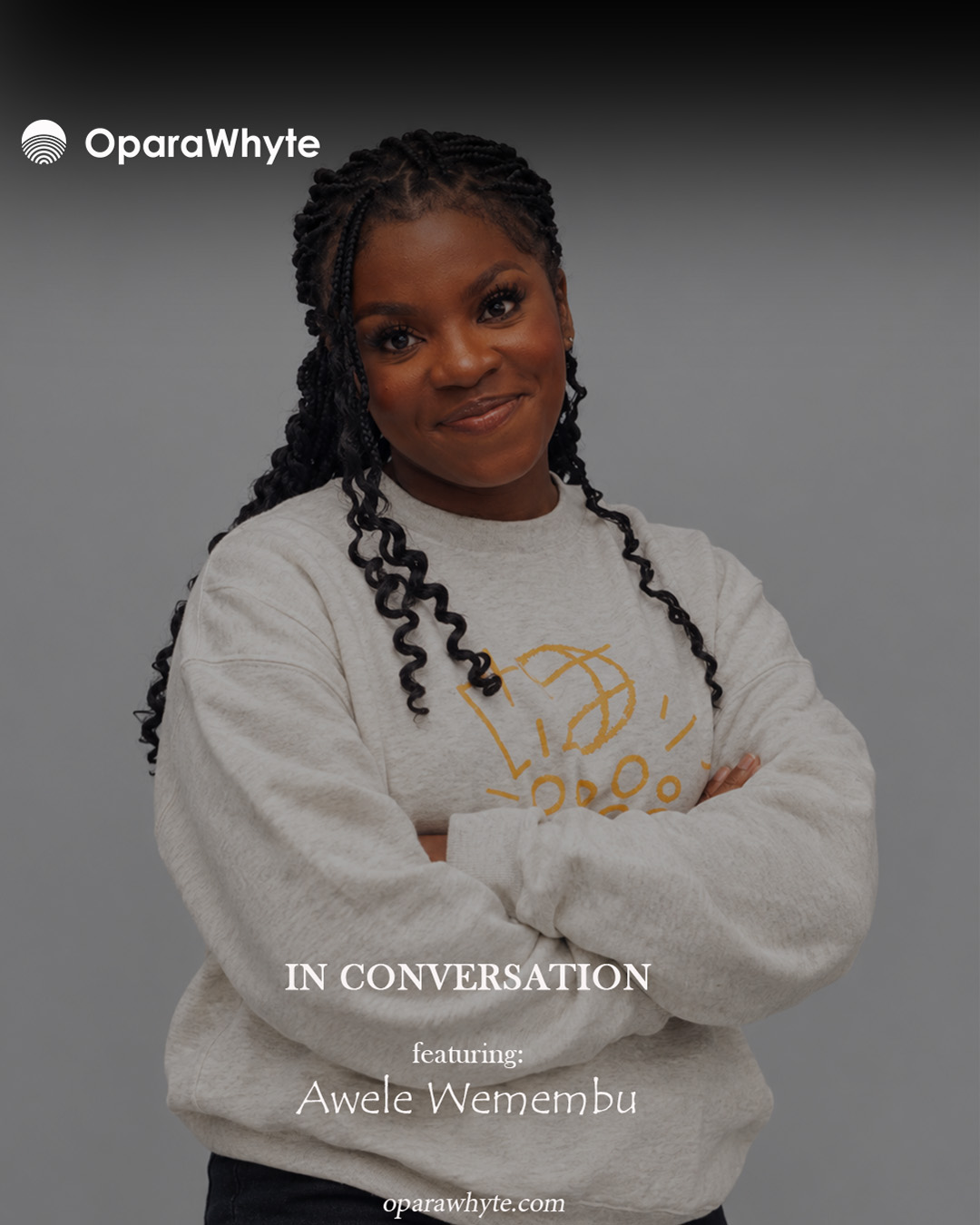
Ms. Awele is a community builder, event organiser, and advocate for meaningful connections and collaboration. Her interests span technology, business, and developer relations, with a particular interest in bringing people, ideas, and opportunities together.
Driven by a desire to create impact, she is passionate about building thriving communities and contributing to initiatives that inspire growth, innovation, and positive change.
In this edition of In Conversation, Oparawhyte’s Frank Clinton sits down with Ms. Awele to explore her perspectives, experiences, and ideas. We invite you into the conversation.
Frank: Why tech?
Awele: Um, the truth is, I didn’t intentionally set out to follow this path. I mean, I studied linguistics in school, and at the time I already had a clear trajectory for my life. You know, finish school, pursue my master’s, become a lecturer and somewhere along the line, it changed. Everything changed. I got an invitation to be a volunteer for a tech event back then in Benin City. It was hosted by Girl Lead. For techies in Benin, they are familiar with what Girl Lead is all about. That was actually the turning point because, through Girl Lead, I got invited to volunteer for more events hosted by Women Tech Makers, Benin, under the flagship of Google Developers Group, Benin. It was actually a panel session that we were having that day, and there was this lady who introduced herself. She said she was working for NNPC back then, and she said, “Oh, she was a software engineer.” It didn’t just make sense in my head because she said, “You read Petroleum Engineering, and you’re working with NNPC,” so, from where to where? That was actually what piqued my interest in the conversation. Because, like I said, I was a volunteer for this event, and to be honest, I wasn’t there because I wanted to learn. I was there because I was bribed to be there. Bribed with food.
Frank: Wow!
Awele: Yes. She introduced herself and she was like, ” Oh, she had like a background in petroleum engineering and but she’s a software engineer.” How? It did not just make sense. So, I just had to follow the conversation. During the networking session, I started interacting with people, and was meeting a lot of persons that said, “Oh I’m studying Microbiology, and I’m doing Data Science.” I’m meeting people who say, “Oh, they’re medical students and they’re probably pursuing a career in front-end development and stuff.” Hold on, this is an entirely different world from what I’m used to, right? Because I mean, back then, “doctors, lawyers,” that was the “it” for people. So, it just felt like they were pushing their academics, but they were pushing for a different career path for themselves. I’m like, “Okay, let me explore.” It was more or less like a challenge. I mean, I had no background, but I reached out to the people who actually introduced me to this event. What areas can I explore? I started asking questions, and to be fair, I’ve had my fair share of exploring in the tech space because I started out in digital marketing, and it didn’t work out for me. You know, I got courses, I was certified and all that stuff, but it wasn’t something that I wanted. I love exploring, but if it’s not a hobby, or if it doesn’t become a hobby for me, I won’t enjoy being in that space. Digital marketing wasn’t working out, so I tried product design. I wouldn’t say I don’t have a creative side, but it wasn’t it. Because what do you mean, you have to think of frameworks and how to build stuff? Not me. There was the software engineering aspect of it. You have to do a lot of calculations. You do Python, JavaScript, depending on what it is you want to focus on. And I’m like, “Nah, nah, nah; I’m not doing this.” I’m not doing this. Coming from somebody who always hated maths. Not that I wasn’t good at math, but I didn’t want it. And I found community management.
Frank: Uuuuu!
Awele: Yes. I discovered that I love networking with people; I love building spaces where people can come, connect, share ideas and build. That’s a safe space, I thought. But I was skeptical about it. Because inasmuch as I discovered that I loved this, to an extent, then, I was a very shy person. Going fully into this would mean that I would have to put myself out there, and I’m just somebody who loves to do things backstage. I don’t like being at the forefront of things. But I came to understand that you can’t really do community management without showing yourself. It was tough, but I got the hang of it. The journey so far has been amazing. It pivoted from just wanting to create spaces where people feel seen, or just connect and build and share ideas, to wanting to empower more women to get into the tech space. And the journey so far has been amazing. I mean, it’s been what? Almost 10 years.
Frank: Wow! Your first time… what was it like?
Awele: My first time at what?
Frank: Being a community manager. How long did it really take you to settle into the role?
Awele: It took me a while. Inasmuch as I was into community management, back then there weren’t really certification courses for community management as a tech course. So, it started with being head of the volunteer team, bringing people together. Say, let’s get this done just to ensure the success of tech events, and it grew into something I’d say was way big because now you’re not just handing people; you’re coordinating events. I started helping out with mapping out plans, ensuring that things were in place for these events that we had back then in Benin City. It went on for a couple of years until I graduated from school. It wasn’t like I intentionally took a pause, but I finished school. I had to come back to Asaba. As of then, there wasn’t really a tech community in Asaba, or so I thought. You know, it’s one thing to have a mindset about something, and then realize that you’ve probably been living in the dark because people are actually doing stuff. On the 8th of July, 2022, which happened to be my birthday, I received a DM from somebody, and she was like, “Hi, I got your number from X Y Z. She said she’s known you for a couple of years, and you guys have done stuff together.” She wanted my expertise in organizing a tech event that they were planning in Asaba, and they wanted me to come on board. I’m like, “Okay, no problem.” I linked up with them. Turns out that they were a Google Developer Group in Asaba.
Frank: Oouuu!
Awele: Yeah. I helped them finalize arrangements for the event because the event was the next day. That would be the first Google I/O event in Asaba under the flagship of GDG, Asaba. From there, I became a part of She Code Africa, Asaba chapter. Became a community manager, and we organized so many amazing events together. Then December 2022, the then lead Godswill Azubuike now asked me to be part of the organizing team for GDG, Asaba. It’s been growth since then. I have moved from being just a member of the organizing team to actually leading the community. I’ve also moved from being the community manager for She Code Africa, Asaba chapter, to being a lead for She Code Africa, Asaba chapter. I’ve also had the opportunity to host so many other events aside from that. It’s been fun. It’s been amazing bringing people together, planning events that you know are not just planned for the sake of planning, but actually having events that have a long-lasting impact on the lives of other people. I’ve seen people who have gotten jobs from these events, who have met mentors, who have met businessmen, who have supported their tech ideas and all that. So yeah, we’ve made an impact.
Frank: What would you say is the biggest impact it made?
Awele: So far? Hmm. I’d say enabling growth in the lives of others. That’s the biggest.
Frank: Is there a particular incident that stands out?
Awele: I can’t really say a particular one, but I’ll give you an example. I’ve had people who have attended tech events who not only get jobs, but get positions in these startups. I mean, starting from a junior dev to a senior software engineer to even becoming a CTO in a fintech. That’s amazing growth. I’ve also had people who have co-founded their own startups just through mentorship with senior colleagues. I like to call them senior colleagues.
Frank: These startups… is there any you would say you are most proud of?
Awele: For the ones that have been built?
Frank: Yeah.
Awele: Um… Yes.
Frank: Which?
Awele: It’s actually a company I’m affiliated with. I’m saying it because the founding team members of that particular startup are all part of the GDG, Asaba community. They came together. They built a product that is now competing with other products on a global scale.
Frank: What product is that?
Awele: Hizo.
Frank: Hizo?
Awele: Yes, Hizo.
Frank: Okay?
Awele: It’s an amazing one. I believe that we’ve built something that has come to stay. Something that has come to enable intra-African payments across borders in Africa.
Frank: I know that being a community manager, you’re not new to interacting with stakeholders across private and public sectors. So, what would you say is the Asaba problem? Oh, I don’t want to call it a problem because sometimes I think the word “problem” has a finality to it. What would you say is the Asaba challenge that you think, if you’re going to build, just know that you will be dealing with this?
Awele: Is it in terms of community, or in terms of people who are trying to build a product?
Frank: Let’s start from community.
Awele: Okay… There was something Mr. Ikechukwu said at Women In Business Summit 2.0, or was it Mr. Chuks? Everybody wants to be a CEO without understanding the nitty-gritty that comes with that position. People feel like once you’re CEO, there’s money unlocked, and then you have funding to spare. But it’s not about that. It’s way more than the title. What are you building? It’s not just about building. What impact is it making in the lives of others? If people actually sit down to think, to look around their immediate environment, they have multiple solutions they can actually come up with to certain problems, but everybody’s looking for the quickest way to do something and then make money from it. Whatever you’re building should be something that has a long-lasting impact on not just your immediate circle, but your community, your state, the nation, and probably Africa or the world at large. So, you find out that most people are just building or coming up with ideas for the sake of “Oh, I want to make money.” Then there’s also a lack of funding. Because, as much as there are persons who probably want to build to make money from it, there are also the ones who have amazing ideas, but there’s a lack of funding for these ideas to actually come to life. But there’s something I learned from Mr. Ikechukwu. Start. Don’t wait till you have people’s money to push your ideas. You can build your product, sell it to people, and then you know that whatever funding you later get is to push it on a national scale or to a global scale. Take, for example, the story of Vent Africa. Even before Vent, there was Olili Food. These startups were self-funded. They didn’t wait to say, “Oh, let’s start applying for funding.” That would have been the most convenient thing for them to do. But they saw that there was a need for delivery service for bachelors who probably don’t have the chance to cook: the convenience of “make I dey house order food,” and they don’t have to drive out or look for keke that would take them to whatever restaurant they want to get food from. They saw there was a need within their immediate environment, and created a solution. So, you don’t have to wait for funding or one big investor to invest in your business. You can start small. By the time 1, 2, 3 people start using your product, if it’s a good service, they will help you do the publicity. By the time you get more users on board, you start looking at expanding, or let’s do some sort of marketing ad to increase users. Since there’s a lack of funding, there’s another option to go about it. But then again, most people will tell you that they have tried, and they’re not getting good feedback from it. So they need investors to push that product. Nevertheless, I’m not faulting anybody. I mean, I’ve not built any product for myself. What I do is help people push and stuff like that.
Frank: What would you say makes a great community?
Awele: Collaboration. Yes.
Frank: There’s something that you highlighted which is very true. Everyone wants to be CEO. Of course, you know that sounds superficial, right? Nonetheless, the indices indicate that it’s true because we seldom have people who want to work for anybody…
Awele: Yeah…
Frank: And I think that in itself is one big conversation to be had. There is collaboration still; there is compensation: sometimes people think they’re not getting their services’ worth; maybe they deserve more. They could have more. In the face of these factors, which bring so much pressure, how have you been able to navigate them to create the community you’ve created? Because if you’ve been here long enough, as you have, and done the amazing things that you’ve done, you couldn’t have done it as a ghost. It’s because you actually know what it takes to get people to work. So, what is it, in over a decade of managing communities, that you can say, “In truth, if I did this, take me anywhere, and I will deliver”?
Awele: I think it still boils down to collaboration and teamwork, because no man is an island of himself or herself. I’m a firm believer that, in as much as I sometimes feel like, “Oh, I can get shit done by myself and all that stuff,” there’s nothing like having capable team members that share the same vision, share the same goal as you. One thing I tell my organizing team: despite a defined yearly calendar, in terms of tech activities for each community to do, I’ll tell you, “I’m not going to be doing events just for the sake of it.” It doesn’t take anything for us to say, “Oh, let’s follow the calendar,” and then we do events. People show up, and then they go back home. What impact are you making? Are you doing an event just for the sake of it, or are you actually creating solutions to the immediate needs of your community members? It’s one thing to gather people and have an amazing lineup of speakers, but if that information is not what they need at that point in time in their lives, that event is as good as useless. So, for me, over the past couple of years, it has been teamwork, having amazing team members, and then collaboration for me. That’s what has been able to get me through all these years. I’ve worked with amazing people, right from Benin down to Asaba. I’ve even had the opportunity of working with people virtually, in terms of certain roles and events we’ve done virtually. So it’s just been about having amazing team members and teamwork.
Frank: Talking about collaboration, has there been a time that you’ve had to give up personal glory just to achieve what you want?
Awele: I’ve never had to take personal glory for anything. If I’ve done something, or if people have felt that I’ve achieved something, it’s because I had a solid team with me. Any day, any time, all day. It has never been just my win. It’s our win because we put in the work. We got the work done. People had sleepless nights. We all had sleepless nights. We put in effort. We showed up. We made contributions, both financially and otherwise. So, it would never just be my glory.
Frank: You’re now the queen of the tech Trinity in Asaba. That’s Olili, Hizo, and Vent, right?
Awele: If you say so. He says.
Frank: This is 2026…
Awele: Yeah..?
Frank: What do you think 2036 is shaping up to look like?
Awele: One step at a time…
Frank: One step at a time…
Awele: Yes, but one thing I’m very, very sure of, with respect to these three companies, is that we are going to be on a global scale, way higher than where we are now. Like I said, we’re building amazing products. It’s not just about building products. We’re solving immediate needs of our environment and creating access for people. For travel, we’re creating access to lifestyle products: from food to groceries to pharmaceuticals to your provisions as well. For Hizo, we’re creating financial access where we’re the middlemen. Now, you don’t have to deal with money exchangers. You can travel to any African country with your app, and rest assured that you can make financial transactions for food stuff, your apartment, transportation, all from one app. So it’s all about access: access to daily provisions, daily utilities that you would need. For Vent, we’re doing the same as well. I see us as a mini bank now that has brought crypto and fiat together. With Vent, you can purchase data, you can purchase airtime, and you can send money to a loved one through your Vent app. You can also trade your crypto, convert your crypto to fiat, and make financial transactions from anywhere in the world. At the end of the day, we’re not just building for the sake of it. We’re building to give people access to daily utilities.
Frank: Talking about products, some of the offers that you have, we already have. The African tech space, or should I limit this to Nigeria, is filled with a host of fintechs. Is there a concern that you might be one too many?
Awele: Of a truth, with respect to fintech, the market is saturated…
Frank: Yeah.
Awele: Some people have built products; they are doing amazing stuff as well. But as I said, for us, it’s all about access.
Frank: For whom?
Awele: For Nigerians. If you can, can you name one fintech that enables you to spend your naira in Tanzania?
Frank: Okay..?
Awele: There’s no platform doing that. There’s no platform enabling you to send money to Morocco or Ghana (I’m talking about your naira now), or South Africa, or Rwanda, or Kenya. So, there are fintechs out there, but are they enabling intra-African transactions? If you check, everybody’s doing USD, pounds, euros, and the rest. But we are trying to bridge that gap within the intra-African market space.
Frank: Is this a political middle finger to the West?
Awele: The goal remains the same: we’re building Africa for Africa by Africans. So, something that’s in the pipeline. We’ve had a lot of persons talk about us enabling transactions from other African countries to other African countries, and not just Naira. So it’s something that we’re currently working on. The major focus at the initial stage was the fact that we cannot spend our naira outside Nigeria. So it was a personal problem that led to building a solution; a solution that became widely accepted because you have Nigerians traveling to places like Tanzania, and they have to convert to USD and then the local currency. That’s just a lot of money exchange going on. So, because these persons had a personal problem, they said, “Okay, let’s build a solution that we can use.” People are like, “We need this,” and they hopped on. I’ve had people come up to me like, “Oh my God, your app saved me when I traveled to Benin. Your app saved me when I traveled to Ghana. Your app saved me when I traveled to Kenya and Rwanda and the like.”
Frank: In essence, you are saying that you are ready for pushback from Western financial heavyweights because you said something about being a middleman. Before now, we understand that the West has been the middleman for Africans. Is this like a knockout blow? What do you think would happen? How would you respond when the West decides to give a little pushback?
Awele: At the end of the day, we’re just trying to enable access. So if it ever gets to that point, we’ll definitely cross the bridge. But right now, it’s one step at a time: enabling access to countries in Africa for Africans to travel without having to deal with the fact that they need to convert to USD and then convert to the country’s local currency. I want to be able to travel to even Madagascar without having to say, “Oh, let me get USD, and then from USD I’m converting to the country’s local currency.” I could just go with my Hizo app.
Frank: It’s interesting seeing what you’re building, right? I remembered when there was some restructuring happening in the banking sector, and we had pushbacks, saboteurs within our system trying to say, “No, you can’t do that” because there stands to be people who benefit from these things. Has that ever crossed the mind of Hizo that you could have people who would say, “No, that puts us out of business” I mean, the very same Africans that you’re trying to get access to.
Awele: We’ve not had that problem, and my stand remains that if we get to that bridge, we’ll definitely cross it.
Frank: That’s interesting. Who would you say is your biggest influence?
Awele: In what regard?
Frank: Career and otherwise… how many big influences have they had?
Awele: Okay… I look up to the likes of Dr. Mrs. Oby. I look up to the likes of Ada Nduka Oyom. I look up to the likes of Dr. Ibukun Owosika. I also look up to the likes of Nwaeze Ikechukwu, my boss, and lastly to the likes of Bianca Ojukwu.
Frank: Interesting… I like that. They are your big five. I would like for us to draw a map. Big Five: who would you say came first?
Awele: Dr. Oby. Dr. Oby.
Frank: How did that happen?
Awele: She’s an icon. Anyway, there’s someone who’s supposed to be on that list. God rest her soul. But these are women that I’ve actually read about as far back as when I was a little girl. I’m talking about the likes of Dora Akunyili. I remember that thing she did with having to follow back-to-back on drugs; it really inspired me. As little as I was, hearing about women doing amazing stuff had me like, “I want to be like these women.” I’ve loved them since way back. Who would I take off that list? A big apology to Mrs. Bianca Ojukwu, since we’re doing the Big Five. Let’s stick to the Big Five. Mrs. Dora Akunyili, Dr. Oby.
Frank: You mentioned the NAFDAC situation; what is it about her that you like?
Awele: Her doggedness.
Frank: Her doggedness. How about Dr. Oby?
Awele: Same, and she’s actually passionate about helping other women as well. I’m coming from a background of “I want other women to be empowered too,” not just in the tech space, but in other industries as well. Seeing her do the same for women as well, it’s a big inspiration. I’ve just always looked up to them.
Frank: All at the same time?
Awele: Yeah, because I mean….
Frank: Is there something that stood out for each of these persons?
Awele: Okay. A little background. As a little girl who was… (I won’t say “was”) I’ve always been ambitious. Imagine having to come out and say, “Oh, I want to do this. I want to do that,” and then people are looking at you like, ” Are you not too small for this dream you have?” But then these women and the things that they do are letting you know that you can’t just be limited. If this person can do this, if Dr. Ngozi Okonjo-Iweala can do this, I can; if Dora Akunyili can do X, Y, Z and even become a force, I can do that. So, these women have always been people I’ve looked up to because they were able to do this, so I can, irrespective of the noise. They walked, and they ran so that people like me could actually fly.
Frank: Talking about your childhood, what would you say is your favourite memory?
Awele: I was a go-getter. Something most people do not actually know is that I wanted to do civil engineering.
Frank: Oh, wow!
Awele: Yes.
Frank: What was that about?
Awele: I’ve always been fascinated by houses and buildings. As a little girl, my mom used to tell me that as far back as when I was two, if you had asked me what you want to do when you grow up, I’ll tell you I want to become an engineer. Smart kid. I started school at a pretty early age that I can’t even say out loud because people look at me weird, like, “What do you mean? What?” But I started school really early, even though there were some sort of hindrances in terms of being just a baby because the age was quite early…
Frank: Is that a year old or something?
Awele: A year and six months…
Frank: That works…
Awele: Yeah, and then my mom would always tell me stories of how, two weeks into resuming kindergarten class, the teacher was complaining that every other pupil was responsive: they were writing, and then this kid just looks, and she’s not comprehending anything. But that’s the idea of sending your child to school. Your teacher should be able to teach you, right?
Frank: Mhmm…
Awele: No child is unteachable, something I always say. You just have to take out time and put in effort. It’s not like I was dull. I’ve always been a smart kid. I’ve always been inquisitive. At that time, I could talk. My mom promised herself that no child of hers would ever be tagged an “olodo.” She’s smart. My dad’s smart, so it should not start with her. And she took time from work and taught me how to write and how to read. Anytime I bump into that particular teacher, because I bump into her, she will tell you, I remain one of the smartest kids that she has ever had in our class. Back then, I used to get accolades for my handwriting, and this is somebody that they said, “Oh, I could not write, but I could.” Before I was five, I had very clean handwriting. So, yes, it’s. been an amazing ride, but yeah, I actually wanted to do civil engineering. But let’s just say life happened, and certain things made me lose interest, and that’s why I moved from the sciences into the arts. But let’s just say I found my passion.
Frank: Did you ever sit to think about why you were fascinated?
Awele: I wonder how people build the structures. Growing up, I had a laptop that belonged to my dad, but when he noticed that I was always on it, he just left it for me. I don’t know how many persons are familiar, but back then we had the likes of Britannica; we had Microsoft Encarta. Imagine having to play games, and then you see some videos showing certain structures, and you’re like, “How did people actually build this stuff?” You’re seeing skyscrapers. This is as far as 2005 or thereabouts. I used to talk about the architects that build structures like this, and you find that most of them are not linked to women. You find more men’s names there. So, I’m like, “I want to be able to do this”
Frank: Yeah…
Awele: Now you’re even checking, and you’re seeing names of other countries and having amazing architectural structures that aren’t even in Nigeria. But it was just it was fascinating. I used to tell my mom back then that I’m going to travel. I’m going to go to places like the US and the UK. I’m going to school. I’m going to learn anything that I need to learn to get what I need to get done and stuff like that. I’ve said a lot. Most persons who are even close to me don’t know this. I’ve actually said a lot.
Frank: Of course. If there’s something that I have discovered, it is that it’s important to define success for yourself. Otherwise, you may never find contentment. So, I know I’ve heard here, and it sounds as though to you “success” is seeing someone else become happy.
Awele: It makes me happy when I see people win. When I see them become everything that they want for themselves, and it’s exciting.
Frank: What about family?
Awele: One step at a time. When I get there, I get there.
Frank: Say you close your eyes and then you see your family. How many children do you see?
Awele: Two.
Frank: Why two?
Awele: Two, please. Preferably, one boy, one girl. But if I have two girls, no problem. But if I do have two boys, I would definitely want a girl. So let’s just make it three.
Frank: Why that number? I think that the world is the way it is because good people like you choose to not have many children.
Awele: Who will cater for them?
Frank: Well, I think that you can do it.
Awele: Yes, I would be able to, but it’s a handful.
Frank: You don’t need a lot to be able to do that.
Awele: Children are a handful. Plus, I have children right now. I mean, my friends are married. They have kids, so those kids are mine. I just need to add two more to have a community.
Frank: You know, it’s like, “To your tent, oh Israel,” and then those kids they have to go back to their tent.
Awele: Eh, that’s why I would want to give birth to my own. By the time I’m saying my other children should come and meet me, they will come and meet me.
Frank: So what defines a husband for you?
Awele: Heeei, blood of Jesus! Blood of Jesus Christ! I want someone who is kind.
Frank: Kind.
Awele: Yes.
Frank: Now, forgive me if I say you should explain what you mean. We live in a world where everyone is an icon, such that we have forgotten what it actually means to be an icon. Every person is a living legend now. So, when you say “kind,” in what sense?
Awele: Someone who is considerate. Someone who is helpful. Someone who is nice not just to me, but to other people, because I’ve had my fair share of people who are nice to you, probably because they’re trying to impress you, and then not to people we tend to regard as lower class. So, the same reception you give to me is what you should probably give to a gateman, to someone who is a nanny.
Frank: At what point do you deduce that you are special if it’s the same treatment? If it’s the same treatment across the board, what then makes you special?
Awele: Me?
Frank: Yeah…
Awele: You don’t have to treat other persons differently for me to be tagged “special.” To be honest, we are supposed to be kind to each other. There shouldn’t be a metric for who you’re kind to and who you are not. It’s not even supposed to be something that’s up for debate. You should, in fact, be kind to people. You should be supportive. You should be generous. He should also share the same values as I do; not necessarily the same visions, but to an extent, our visions and our goals should align in a way. But even if they are not aligned, you should be able to support me, not see me as competition because I’m very, very ambitious, very, very. So I don’t want someone who feels I’m competition, and then you probably want to suppress my goals or my dreams for myself, or get me to eliminate myself or downplay myself just because I’m supposed to make you look good.
Frank: Have you suffered something like that: a situation where you had to muffle the voice of your ambition while trying to cater to a romantic relationship?
Awele: Not exactly, but I’ve had someone tell me that I’m so ambitious and independent.
Frank: Too ambitious to be a wife?
Awele: Probably to him. I think, to an extent, he felt intimidated.
Frank: Of course, I like that you mentioned the idea of independence. Research shows men like to feel needed.
Awele: Men like to feel needed…
Frank: Men are placed to do things…
Awele: True…
Frank: And it becomes a source of internal conflict for the man, should he not have anything tangible, and I’m not even necessarily talking about spending money, to do, which again is one elephant in the room that should be addressed because the need of the 21st-century woman is different from the need of the 2oth-century woman.
Awele: That was because…
Frank: She has literally what the 20th-century woman couldn’t afford, which the 20th-century man provided. But now that the 21st-century woman has pretty much everything, seemingly, the 21st-century man raised by a 20th-century man is at a loss. It’s like you spend the time going up the mountain to receive the commandment, and by the time you’re down, the people have already molded for themselves a golden calf. Did I go through all of this in vain? Seeing that you are an excellent community manager, and of course I do not doubt that we have young ladies who come to you and talk to you about these things. What philosophy have you been able to pass on to help them navigate this supposed dilemma of career-love relationship balance?
Awele: Do you. The fact that something works for me doesn’t mean it works for the next person. We are all different individuals from different backgrounds. Do you. Because I might tell you what works for me, and it probably doesn’t work for you, and it might not work for you, but it will work for the next person. As far as it makes you happy, and you know that whatever you’re doing is right, and not to the detriment of other people. Just do you. Honestly speaking, do you. At the end of the day, you seeking information from me will still go to another person who will feed you something probably different from what I would say. So, just do you. Do what makes you happy, and just make sure that you’re not putting your career on hold for anybody. Sorry, I’m not in support of that.
Frank: Do you think that at some point that has to happen, especially with childbearing?
Awele: Everybody has goals for themselves. Before you get involved with someone, you should have discussions on what you want your life to look like in the next five years, or in the next 2-3 years. So, if you have a conversation with your partner, and then you’re in agreement that at a certain point in time, we would need to start having children, no problem. Work with it. But if it’s something that your partner is not seeing eye to eye with, there should be common ground. I will not say we leave the partner because the person is not… there should be common ground. And if it’s not working for either of you, and you choose to say, “Oh, I can’t be with somebody who does not want to work on my timeline,” it’s your business. I will not tell you what to do with your relationship. Like our people will say, “They no dey advise people wey dey in love.” It’s the truth. So, just do you.
Frank: A life like yours is one of those lives that you look at, and you wonder: Do they ever have any pain, or does this person ever go through trouble?
Awele: We are all going through trouble.
Frank: So, is there a publicly known setback that you have faced?
Awele: No.
Frank: Why? How have you managed to keep it airtight?
Awele: I’ve just done my best. People don’t talk about their problems on social media.
Frank: I don’t know what part of social media you’re talking about because everybody seems to have turned social media into their private journals.
Awele: Never, ever, ever have I posted any of my problems on social media.
Frank: What’s the rationale?
Awele: In what terms?
Frank: Not putting it out there that they had a hard time because people nowadays glory in having a hard time.
Awele: I’m not even a social media person to begin with. I don’t even have an online presence. I think the last time I posted on LinkedIn was in 2024, and I think I reposted someone’s post last year. My Instagram page only just started becoming active at the end of last year, thereabouts. My WhatsApp: I post memes; I catch “cruise.” It’s social media. It’s what I want you to see that you see. What you will never see is me posting my problems. I deal with my shit. My circle is small and tight. That’s actually something I’m very grateful for.
Frank: Talking about circles that are small and tight. How did you pick your circle?
Awele: Ah, I didn’t pick them until they found me.
Frank: Interesting!
Awele: First of all, I don’t know how to keep friends. Those are people who have known me- they have seen me, and they decided to stay. Cause, for me, you know, that whole keeping in touch, I sometimes ghost.
Frank: You’re not the calling type
Awele: I’m not even a texting type.
Frank: I figured. That’s why my dm is so…
Awele: I’m so sorry… I sometimes ghost, but these are people who understand me and understand the kind of person I am. Inasmuch as I’m lacking in that part, they are willing to make time. These are people who make time to be there for me, to check up on me, to support me, to cheer me on, to advise me when necessary, and stuff like that. So I won’t say I found them. Though most of them, I did meet them at certain places, right? Like my best friend, I met her in uni. And honestly, if anyone had told me that would be that close. I’d say it’s a lie.
Frank: Wow, is it like those initial finds?
Awele: No.
Frank: Squabble at first sight or something like that?
Awele: She got my name right.
Frank: Oh, really?
Awele: Yes.
Frank: So, which of the names did she get right?
Awele: My native name.
Frank: What’s that?
Awele: Awelechukwuka.
Frank: Awelechukwuka.
Awele: Yeah. I schooled in Uniben…
Frank: I got it right, yes?
Awele: Yes, you did.
Frank: So that counts for something…
Awele: No, we’re not friends.
Frank: Hahaha. Okay.
Awele: As I said, I studied at the University of Benin, and we had most Igbo people in our class, but we had more Edos, more Benins, Yorubas, and a few Hausas in our class. Now I had gotten used to just telling people my English name, and then I’m meeting this person who’s…
Frank: I’m not sure I’ve heard your English name.
Awele: Please, you will not.
Frank: What’s your English name?
Awele: Don’t worry.
Frank: Seriously?
Awele: No. Then I’m meeting this person who’s saying, “Tell me your native name, jhoor; I’m not using your English name to do anything.” I’ve had cases where I tell people, and they mispronounce it. And she’s like, “Tell me.” I told her. She pronounced it easily. At that point, I didn’t need to tell people Awelechukwuka. You’d hear pronunciations like “Ewere” or “Ewele,” and she goes, ” Oh, is your name Ijeawele or Awelechukwuka or something? I look at her like, “Who is this person?” She was like, “Don’t look at me like that. I’m from Delta State too.” I’m like, “Oh, now I know why she was able to pronounce it well.” And we clicked.
Frank: What is it about your name? What’s behind the name Awelechukwuka? The name seems precious to you.
Awele: The funny thing is, I never did like that name.
Frank: Which of your names is your favourite?
Awele: Now? It’s my native name.
Frank: No, before that.
Awele: My English name.
Frank: So, at what point did that change?
Awele: Certain events happened. I marveled at those occurrences because these are things that, if ears were to hear them, people would be like, “How are you still here? Or how are you still standing?” My mom will remind me that your name is actually working for you. Awelechukwuka: “the blessing of God is greater,” or most persons interpret it to be “the favor of God is greater than anything else.” It has worked for me. You know, they’ll say the name you give your child is actually very important. There’s a spirit backing the name for me, and it has always worked for me. Most people say, “Oh, you’re lucky in certain cases or certain scenarios.” I’m like, “No, it’s my name that’s just working for me. It’s just my name. I think about these experiences, I’m like, truly, truly, I for no actually survive. I tell my mom, I’m definitely God’s favourite child. I don’t know what anybody says. I’m God’s favourite child because the Man loves me too much. He’s obsessed with his creation.
Frank: So all of that and you embraced it. You embracing your native name is like a road-to-Damascus kind of encounter. It took events to get you to the point where you said, ” You know what? I might just adopt this thing.”
Awele: I wouldn’t say it necessarily took events. Fun fact, I actually didn’t like both my names. Yes, to be honest, but I embraced the English name more because, I mean, it’s easy for people to pronounce and it’s kind of popular to an extent.
Frank: Please don’t tell me it’s Joy.
Awele: I’m not even going to answer that question because you are going to play a guessing game now. So I don’t want to go there with you.
Frank: Okay.
Awele: There are names like Victoria, names like Elizabeth, Desire, Roosevelt, names like Aurora…
Frank: How many names have you mentioned now?
Awele: Five.
Frank: Five names, yes?
Awele: Yes.
Frank: Five babies…
Awele: Ehnn? You and who, five babies? These are names that are just actually sweet to the ears. Then you have native names like Zarachi that you can actually shorten to Zara, or Kamsi, Kami, or Chimamanda that you can actually shorten to Amanda. I’m like, you were just lazy. But now I realize that there was actually intention behind it. By the way, it wasn’t even my dad; neither was it my mom who gave me my native name.
Frank: Who did?
Awele: It was community.
Frank: Your community?
Awele: Community of family members. They started calling me “Awele” long before my naming ceremony. When it was time to name the child, they were like, “Oh, the native name is supposed to be given by the grandfather of the child.” Yeah, and I had just one grandfather, my mom’s dad. He comes up and says, “We’ve already started calling her a name.” My dad is sitting there. He’s fuming. Like he wanted to give me “Uche,” and then this old man comes up and is like, “Awelechukwuka.” Everybody’s like, “Yes, yes, that’s the name we want.” The name already stuck. Just went along with Awelechukwuka. It has worked for me. It has followed me, and I’m just grateful for it.
Frank: Are you saying that you have put thought into the names of your children?
Awele: Yes.
Frank: So much so that, of course, looking at how your name has worked for you, you factored that into it. What was your secondary school like?
Awele: It was crazy. And it was adventurous.
Frank: Ooouuuu, me likey! Did you like, scale the fence or something?
Awele: No. I was too girly for that.
Frank: I can imagine. So, what would you say your top three memories from secondary school are?
Awele: One. Having to escape punishment.
Frank: Wow!
Awele: Yeah, there was this girl who used to faint any time our class would get punished. Once we’re punished like this, we’d be like, “Funmi, please faint. Funmi, please faint.” It used to be so perfectly timed. I would stay close to her. By the time they want to flog her (they’ve probably flogged every other person), we who are closer to her will be like, “Funmi, please faint, faint, faint, faint.” And then once they just come in, she’d be like, “Ah.” So we’re like, “Yes, that’s it.” And our principal goes, “All of you, get back into your classes. You, you, you, carry her.” We would be like, “Thank you, Jesus!” Another thing would be when we were chased home. Our principal had gone round with the account book to know persons that had not paid school fees to send them home…
Frank: And you joined them…
Awele: I joined them. Funny thing, my dad had given me my school fees receipt, but I’m like, okay, they’re going to chase for school fees today because He pays early, but most times he forgets to log in the receipt. The night before, I’d reminded him. But I got to school that day, and my friend had not paid hers, so I’m like, okay, if they’re chasing, let them chase all of us. After all, we would have math class afterwards; an opportunity to skip math class. The principal comes and calls the defaulters’ names, and my name was on the list. I bounce out with my bag, like I’m gonna go somewhere to chill, and then once school closes, I come back because they always come pick us up from school. As I was stepping out with my clique, our vice principal sights me. “Awele, you come here.” “Good morning, ma,” I said. “What are you doing there?” “They chased us for school fees,” I replied. She’s like, “You’ve never defaulted on school fees. Come here, let me call your father.” This woman picked up her phone and she called my dad. My father said, “No, I’ve actually given her the receipt nau. I’ve paid.” She said, “Ehen,” because she knew that I had never defaulted. My dad said, “Give her the phone.” I told him that I forgot the notebook that I put in the receipt. “Okay, no problem; give the phone back to your VP.” She was like, “No, no, no,” that we’ve never defaulted and I should go back to class. I’m like, “Blood of Jesus! Who sent this woman?” Another time would be when we were supposed to do something in school, but we were told that students who were in Fine and Applied Arts would get exempted…
Frank: Interesting!
Awele: So I carried myself to sign up for Fine and Applied Arts class. That was how I found myself doing tie and dye, doing mosaic art, and doing a lot of stuff.
Frank: What does it mean to be a first daughter?
Awele: It means to set the pace for others to follow.
Frank: How much pressure comes with setting the pace for others to follow?
Awele: So much pressure.
Frank: Do you think that there’s room to make mistakes?
Awele: No.
Frank: At what point did you begin to feel this pressure?
Awele: From when I was 8.
Frank: What happened at that age?
Awele: I started to look after my siblings from a very young age. And everybody believes that you have to give everything your best because you lead and your siblings follow. So, there was no room for mistakes. I mean, you have kids that are looking up to you, who believe that I have a big sister and she should be able to lead right. There’s this scrutiny, sometimes unspoken, when you fail. There’s no shoulder to lean on because no one expects you to fail in the first place. So, you fail, and you’re reprimanded. There was no room for you to just fail. You could not afford to. Even when you probably had setbacks, there was no one to console you. So, it just left you all alone to deal with it, whatever the consequences were and then you build yourself up again because you can’t remain on the ground or cry for too long.
Frank: Would you say you have found a big sister?
Awele: In whom?
Frank: Or do you think you’d ever find one?
Awele: Maybe. Maybe not. But I’ve always had to do my shit myself. As I said, there’s no room for mistakes. The world is moving. Nobody will stop and wait for you to say, I want to cry. I need time to talk about my losses.
Frank: Should it be like that?
Awele: Honestly, no. But life has never really been kind to firstborns or first daughters.
Frank: With all of this, at what point have you stopped to actually live for yourself?
Awele: I am currently living for myself. One of the biggest challenges I had- I said “had” because I couldn’t say “No” to my siblings. I just had this mentality that whatever I was doing was for them. It was tough; it was stressful. Some days, I’m like, Can I just breathe? But as I said, you don’t have time to wallow.
Frank: You said, “Had.” At what point did it dawn on you to begin trying to live for yourself?
Awele: The past couple of months have been trying. Stuff has happened, experiences have been lived through, and I just realized that I haven’t lived for myself. The funny thing is, inasmuch as I’ve said I’m going to live life, there are certain points where I would certainly worry about people around me. It’s an inbuilt attribute. So, It’s not something I can wake up and shake off. That concern for other people will always be there. But if it’s out of my control, there’s nothing I can do. I won’t kill myself for anybody. All I can do is offer you the support I can; the rest is between you and God.
Frank: Something that we don’t talk about enough is, for firstborns, there’s no blueprint. Your parents did a test run on parenting with you. You were their first child, and all the mistakes they made, they made with you. You now find that there could be five of you, but you all didn’t have the same parents. Have you been at that point where you struggled with reconciling your perception of your parents with that of your siblings?
Awele: It’s never the same.
Frank: Has there been a moment you felt, “But they didn’t do that for me”?
Awele: Yeah, Several times.
Frank: How were you able to deal with that?
Awele: I didn’t deal with it.
Frank: What did you do?
Awele: I just had to move on.
Frank: How long can a person move on until things begin to catch up?
Awele: You just have to keep moving
Frank: With hopes that they don’t catch up?
Awele: With hopes that they don’t catch up.
Frank: Correct me if I’m wrong. I perceive you to be someone who seeks to right wrongs, not necessarily for the purpose of righting wrongs but with the sole aim of ensuring that it doesn’t happen again.
Awele: Mhmm
Frank: So, you don’t like to dwell on symptoms. You like to find the root cause. With that perception of you in mind, what do you think you’d do differently to provide support for the firstborn?
Awele: Hmm. That’s quite a tricky one. But I’ll say friendship.
Frank: Okay?
Awele: One that allows for effective communication, active listening and support. I’m not talking about financial support.
Frank: I know you’ve said that you’re not a very good friend. But I beg to differ. Again, correct me if I’m wrong. I think that you’re one of those friends who are not very loud. It’s like, you’re sitting quietly in the corner, watching everyone make noise and getting the place bubbly. But when push comes to shove, you’ll be the only one left. With children, how would you manage initiating the friendship, seeing that you’re not one to talk?
Awele: I am one to talk when the need arises. The fact is, I’m probably not too big on “talking to my friends.” At the end of the day, they are your friends; this is my child I’m talking about. There are some experiences that I have had to live through that I wouldn’t want my child to live through. I will do just that.
Frank: Will you say that you are big on family?
Awele: I am big on family. Very, very big on family.
Frank: I can tell. I think that you’re enthusiastic about your work. But when it comes to family, it’s not enthusiasm. It’s not just stringing words. It’s something much more than that. Although you try to be careful in your expression of that emotion. I think that there are things you are very capable of that a lot of people don’t know until the subject matter of family is talked about.
Awele: Probably.
Frank: For you, family is at the core of everything. So, would you say that your approach to community management is with a sense of family?
Awele: It has always been.
Frank: So, you’re more or less the big mummy?
Awele: Mhmm
Frank: So, when does mummy rest?
Awele: Do mothers actually rest?
Frank: That’s surprising. If we say that mothers do not actually rest, how come they live longer than fathers?
Awele: They know when to pause but they don’t actually rest.
Frank: What’s the difference between pausing and resting?
Awele: Probably take a break or step back for a while. But if there’s ever any emergency, the mother will come forward. Taking a break or a pause doesn’t mean she’s not observing; she’s only doing in the shadows what she would do out front.
Frank: Then again, is she really taking a pause?
Awele: In a way, she is. That’s why I said it’s different from taking a rest.
Frank: What is it about motherhood that you love most?
Awele: I think I love everything.
Frank: Of course, we can’t cherry-pick. If there could be a word that sums up motherhood, what would it be?
Awele: Protector.
Frank: Is it possible for one to lose it all while trying to protect it?
Awele: Lose what?
Frank: Lose everything.
Awele: Are we talking about career or are we talking about children?
Frank: We are talking about both. I like that you asked for that distinction. Because sometimes it’s almost as though you treat both the same way.
Awele: In a way, yes.
Frank: So, yeah.
Awele: Lose it all to protect my kids? Yes. But lose my kids to protect a career? No.
Frank: Why? What is it about children? You can always make new ones.
Awele: You think?
Frank: Well, I know.
Awele: It’s never the same.
Frank: How so?
Awele: A woman or a mother can lose a child and have other children. But even if she doesn’t show it, there are times she thinks about the ones she’s lost. And there’s this wishing on the probability of a chance that time could rewind and just…
Frank: How do you deal with loss?
Awele: Do we ever deal with loss? You don’t come back from that. Then again, it depends on how close you were to the person. You might get on with your day but there are times when it hits you. And you just have to bottle up emotions. I don’t know about other people; I’m just talking about myself. Just bottle up emotions and remind yourself that the person will not want you to be sad or grieve.
Frank: Ms. Awele, it’s been fun sitting here and talking with you.
Awele: Likewise.
